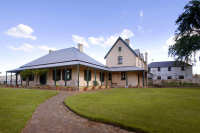
It is classed as one of the most historic Tasmanian colonial houses and was built around 1819 by Thomas Haydock Reibey, the eldest son of Mary and Thomas Reibey of Sydney. His mother Mary was convicted of stealing a horse and transported to Sydney for 7 years when she was 13. She is featured on our $20 note.

My sister in law works there and we have had the run of the house for the afternoon. While she was working, I was looking around on the net and found a fascinating story.
Copyright Carmel Bird 2002
www.carmelbird.com
Entally House was built on the outskirts of Launceston in 1820, and when I lived in Launceston as a child I liked to go there. It was open to the public. These were early days for the industry of early colonial Australian houses, and people were free to roam through the grounds and rooms of Entally without guides or barriers or security cameras. Like the Joss House at the museum, Entally was naively open to the touch. Modern museums now have much that can be touched, much that encourages interactivity between visitors and exhibits. It is a very different kind of interactivity from the old-fashioned kind whereby you could play the piano at Entally if you wanted to. Obviously modern tourism and education can’t allow that kind of thing, and I am not arguing one way or the other – I simply record the way things used to be, and note the way things are. At Entally some time in the nineteen fifties I engaged in a particular kind of interactivity, as I will explain.
There was a seductive air of sadness and nostalgia, and I enjoyed lingering under the huge English trees, in the stables where there were old carriages, and in the sparse little chapel. I should explain that I did all this by myself; I didn’t know anyone else who would be interested. The facade of the house was quaintly gabled, the edges of the gables simply decorated with a little frill. Although this was a rather grand estate in colonial times, the scale of the house is small; it seemed to me, even when I was a child, that the people must have been tiny. You could have Devonshire Tea in the conservatory, but there were not really many visitors.
I was fascinated (to the point of being entranced, delivered into a dream as I was in the Joss House) by the atmosphere of past lives which I could feel at Entally as I went slowly from drawing-room to kitchen to the pinched and narrow staircase which wound up to the second floor. I am sorry to say I never saw the ghost that used to appear on this staircase. My visits all took place in the daytime, and the ghost, an Indian wearing a turban, or else a Lascar with a head-scarf, comes out only at night, after a sharp drop in the temperature on the stairs. He has apparently appeared only to women, one of whom went mad as a result.
I don’t know why this ghost is there, but the explanation for his exotic nature lies in the fact that the family of Entally (incidentally descended from a convict, Mary Reibey) were ship-owners trading with the East. The ghost had somehow wandered from the commercial life of the family into their daily lives, taking up (why?) his position in the gloomy shadows of the stairs back staircase. To me, the flavour of mystery and violence and dusky slaves and adventure on the high seas, not to mention the story of the woman who went mad, was quite stimulating. I just used to hang out there, and somehow breathe it in. My memory and imagination are furnished with images of dark brown velvet curtains at the foot of the stairs, looped back with a golden cord.
I used to like going up the stairs, conscious that I was treading in the footsteps of the Lascar or the Indian, to the nursery where there were old cots and prams and dolls. Faded black and white photographs of young children in elaborate clothing, frilly bonnets and button boots, stared solemnly from silver picture frames. The floorboards shifted and clattered beneath the faded blue rug. The silence was strange; the solitude was somehow rich in possibilities. I was alone in the presence of the past, in the company of the ghosts of children. As far as I knew, the children grew up and moved on, but there was a haunting sadness in the nursery, a sense that the children in the pictures had one day set down their toys and fallen into a sleep from which they had never awoken. In those days places like Entally didn’t give you much documentation – so I was perfectly free to invent the narratives of the house from the evidence before my eyes.
I wanted to invent, and I did so, but I also wanted to find a way to interact with that narrative, to somehow enter the story. One thing you can do, in those circumstances, is take something away. This is the principal of the souvenir. But they did not, as they now do, sell souvenirs at Entally where you can buy jam and lavender and so on. And I didn’t steal anything. The other possibility is to leave something behind, such as graffiti. I didn’t do that either. I don’t know how I came up with the plan for what I did, but here it is.
One day at home I made a very very tiny rag doll, about as big as your little finger, with real hair, an old-fashioned pinafore and an embroidered face. She was called Isabella, and was meant to resemble closely a doll that might have belonged to a child who might have lived in the nineteenth century, to be perhaps mistaken for such a doll. The next time I went to Entally, I took this doll, and I lifted the blue rug, and then I lifted a loose floorboard and I placed the doll in the space, and replaced the board and the mat. The room looked the same as it had before, the rug was flat, the faded faces stared unblinking from the picture frames. I felt marvellous. Isabella was in place, an insertion into history, a false clue.
On my recent visit I saw with no surprise that progress has brought about change, has added a souvenir shop and safety ropes and probably security cameras. The narrow staircase was just as I had remembered it. The plain wooden floor of the nursery was polished now, and covered with a different rug. The cots, the prams, the dolls, the photographs were all there for me to see, but the doorway was blocked off with iron bars. I searched for Isabella among the small treasures in glass cases. She wasn’t there. Well, perhaps she has been eaten by rats. Perhaps she has simply rotted away. Or perhaps she is still there, waiting beneath the floorboard to be discovered when the time comes. All I could do was take a few photos through the bars across the doorway. No doubt another illegal act of interactivity
As you can imagine, my sister in law and I were excited. Our own mystery. We ran up the stairs, unlocked the room and snooped around. The carpet has been tacked to the floorboards so we were restricted in our access.
My sister in law tells me they are planning to move the upstairs exhibits downstairs and move the offices upstairs. This is so the elderly don't have to navigate the stairs to see the "doll's room".
I can't wait to see what they find and have emailed Carmel to tell her. I think I will need to come back to Tassie that day. Below are some comments from Carmel
30/3/2009
How amazing and exciting to receive your email.
What if your sister in law finds the doll intact!!!
It is - as I recall - about two or three inches tall.
Even if it is not intact, there might at least be traces.
I await further bulletins.
30/3/2009
As I recall - I lifted a loose floorboard and there was dusty space
there and I quickly dropped the rag doll, replaced the board, and
scurried off.
I had often been there - so I knew about the boards - there might have
been several.
As to WHERE in the room - I think it was possibly close to the centre
- a bit to the right - if that makes sense.
But it was probably been eaten by mice - don't you think?
or even thrown out in a decayed condition when the room was revamped.
The room as it is now is quite different from what it was when I was a
child.
2/4/2009
I realise I forgot to say what she should look like.
Well, sixty years ago she was between two and three inches tall.
Body (inc head and limbs) made from old white sheeting, stuffed
with a little bit of cotton wool.
Face drawn with pencil.
Hair made from black embroidery thread.
Dress from scrap of floral cotton.
| | |
| | Report to moderator  220.238.105.7 220.238.105.7 |


